|

Power-2-Light Challenge: Generator Sizing
Sizing a portable generator for a lighting load can be very complicated. When you use lights sources like HMIs, Kinos, CLF lamp banks, & even LEDs, on generators it matters not only what type of generator you use
but also what type of ballasts the lights use. That is because the poor Power Factor and Harmonic Noise that magnetic and non-Power Factor Corrected electronic ballasts (HMI, Kino, CFL, & LED included) kick back into
the power stream can have a severe adverse effect on the power waveform of some generators, but not others.
For example, what size generator is required to power a small lighting package consisting of a 800W Joker Buglite and two 40W 1x1 Litepanels? You would think that you could operate this lighting package on a conventional 1000W generator (800W+40W+40W= 880W.) However, when your lighting package consists predominantly HMIs, Kinos, CLF lamp banks, & even LEDs, you must consider the Power Factor of the lights when calculating the load that you will put on the generator. A careful analysis of the Power Factor of the Joker 800 and 1x1 Litepanel indicates that our lighting package would in fact overload a conventional 1000W generator.
If we look at the technical specifications for the Joker 800 Buglite, we see that it uses a non-Power Factor Corrected ballast with a Power Factor of .58. According to the K5600 website, the Joker 800 ballast draws 12.5 Amps rather than
the 7 Amps you would think using Ohm's Law (800W/110V=7.2A.) What that means is that it has an Apparent Power of 1375W (110V x 12.5A = 1375W) or draws nearly twice the power to generate 800W of light output than a quartz instrument of
the same wattage. Used on wall outlets, this relatively inefficient use of power is negligible because the power draw of the Joker 800 fits easily in a standard wall circuit. However, the greater Apparent Power of the Joker 800 must be
factored when using portable generators because the generator must be sized to supply the Apparent Power (1375W), even though only the True Power (800W) provides light.
The same is true when it comes to the 1x1 Litepanels. According to the manufacturer, the AC-to-DC power supply that Litepanel uses for their 1x1 fixtures has a Power Factor of .54 and so draws nearly twice the power (an Apparent Power
of 75W) for it's true power output of 40W. If you were to use this lighting package on a 1000W conventional generator, the total Apparent Power of 1525W (1375W + 75W + 75W = 1525W), would overload the generator because the "continuous load"
rating of 1000W conventional generators are usually only 850W. Even though it's power is cleaner and more stable, you would not be able to run this package on a Honda EU1000is Inverter Generator either because, with a continuous load rating
of 900W, the accumulative load of 1525W would also overload a 1000W inverter generator.
Could you operate this lighting package on a 2000W conventional generator? Again, the answer is "no" because the greater Apparent Power of lights with a poor Power Factor is not the only consideration when operating them on conventional
generators. Of equal importance, is the Harmonic Noise that ballasts with poor Power Factor kick back into the power stream that severely limits the total amount of Leading Power Factor loads, as compared to Unity Power Factor loads,
that can be reliably operated on conventional generators.

Left: Grid Power w/ 1.2Kw Arri non-PFC Elec. Ballast. Center: Conventional AVR Power w/ 1.2Kw Arri non-PFC Elec. Ballast. Right: Inverter Power w/ 1.2Kw Arri non-PFC Elec. Ballast.
Given the large sub-transient impedance of conventional generators, as the oscilloscope shots above illustrate, even a small degree of harmonic noise being fed back into the power stream will result in a large amount of distortion in its'
voltage. Add to that, the fact that the original supply voltage waveform of conventional generators is appreciably distorted to begin with, and you have a situation where the return of any harmonic currents by a non-PFC HMI, Fluorescent, or
LED ballast will result in significant waveform distortion of the voltage at the power bus and operational problems with the generator voltage and frequency regulation.
This is graphically illustrated in the You-Tube video, "Compact Fluorescent verses The Generator", by Lighting Designer Kevan Shaw's (available on-line at href="http://www.youtube.com/watch?v=LeCqreRMzKM, when he is not able to operate
an equivalent Apparent Power of CFLs, as he could incandescent light, on his small 850W generator.
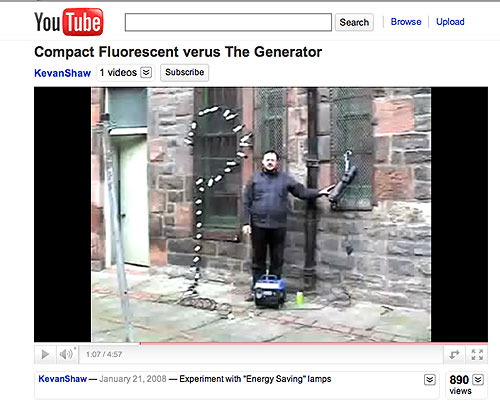
In fact, Kevan Shaw's You-Tube video illustrates the general rule of thumb that it is not possible to load conventional generators beyond roughly 65% of their rated capacity for more than a short period when the load consists of lights
with a poor Leading Power Factor ( Max Apparent Power of 540W/850W Generator = .64) Which translates to a maximum load of 1300W on a 2000W conventional generator. Where the total Apparent Power of our lighting package consisting of a
Joker 800 and a couple of 40W 1x1 Litepanels is 1525W, it will overload even a 2000W conventional generator.
Will our lighting package operate on a 2000W inverter generator like the Honda EU2000is? The oscilloscope shots above indicate that it would. Even though the non-PFC ballasts of our lighting package kick back the same harmonic currents,
the voltage waveform of inverter generators retain an over all sinusoidal shape because of their lower system impedance and purer original power waveform. The appreciable difference in voltage distortion created here by the same light
demonstrates that an inverter generator will provide cleaner power, and operate more reliably, regardless of the type of load.

Left: Grid Power w/ 1.2Kw P-2-L PFC Elec. Ballast. Center: Conventional AVR Power w/ 1.2Kw P-2-L PFC Elec. Ballast. Right: Inverter Power w/ 1.2Kw P-2-L PFC Elec. Ballast.
As the oscilloscope shots above illustrate, Power Factor Correction can be of tremendous benefit when operating HMIs, Kinos, and LEDs on portable gas generators because a PFC circuit realigns voltage and current, eliminates the generation
of harmonic currents, and induces a smoother power waveform at the distribution bus. PFC circuits successfully increase the power factor to as much as .98, making ballasts with it near linear loads. As a result, the ballast uses power more
efficiently with minimized return current and line noise and also reduces heat, thereby increasing their reliability. For instance, if you were to replace the Joker Ballast with a Power-2-Light 800W PFC HMI ballast instead, the same head
would draw 8 Amps at 110 Volts (instead of 12.5) and have an Apparent Power of only 880 Watts. If you were also able to replace the non-PFC AC power supplies of the 1x1 Litepanels with Power Factor Corrected ones, the oscilloscope shots
above also indicate that you would likely be able to operate the whole package on a 1000W inverter generator (880W + 40W + 40W = 960W.)
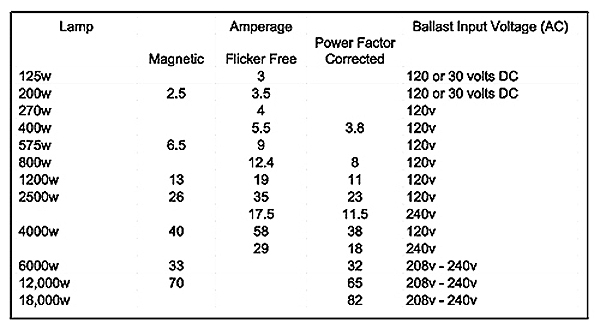
What is true of small lighting loads on small generators, is also true of larger lighting loads on larger generators. For instance, before reading this article, you would have thought that you could reliably operate a 4k HMI with non-PFC
ballast on a conventional 6500W generator. But, where a non-PFC 4k electronic ballast will draw 58A at 120V it will overload a 6500W. To understand why, simply compare its' Apparent Power of 6960W (58A x 120V = 6960W), to the continuous
load capacity of a conventional 6500W generator after de-rating it for a load with Leading Power Factor of .58 (6500W x .65 = 4225W.) Likewise, if you were to replace the non-PFC 4k electronic ballast with a Power Factor Corrected one,
the light would only draw 38A at 120V and have an Apparent Power of 4560W. And since, the ballast has a near Unity Power Factor, the 6500W generator would not have to be de-rated, and so could operate the 4560W Apparent Power load without
a problem.
The poor Power Factor of HMIs, Kinos, CLF lamp banks, and even LEDs, have been vexing set electricians for years. I wrote an article for our company newsletter
that explains the electrical engineering principles behind these issues and how to resolve them.

This article is cited in the just released 4th Edition of Harry Box's "Set Lighting Technician's Handbook" and featured on the companion website Box Book Extras. Of the article Harry Box exclaims:
"Great work!... this is the kind of thing I think very few technician's ever get to see, and as a result many people have absolutely no idea why things stop working."
"Following the prescriptions contained in this article enables the operation of bigger lights, or more smaller lights,
on portable generators than has ever been possible before."
The article is available online at http://www.screenlightandgrip.com/html/emailnewsletter_generators.html.
Guy Holt, Gaffer, ScreenLight & Grip, Lightng & Grip Rental in Boston
__________________________________________________________________
Each component of our
"HD Plug & Play Package"
is available for
Rental or Sale
(Financing available - Please Inq.)
__________________________________________________________________
|